A 90% Win Rate That Loses Money: The Win-Rate Trap
Win rate is the most cited and most misleading number in trading. Here's how a strategy that wins 90% of the time can still bleed you dry — and what to track instead.
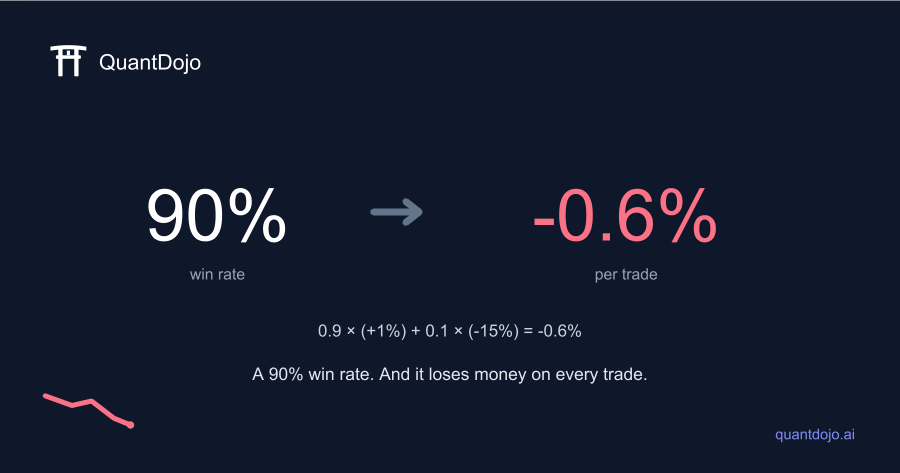
Win rate is the number every strategy seller leads with — "wins 9 out of 10 trades!" — and it's the most misleading metric in all of trading.
Here's the uncomfortable truth: a strategy can win 90% of its trades and still send your account to zero.
The math nobody screenshots
Say you win 90% of the time, and each winner makes +1%. Sounds unstoppable. But suppose the rare 10% of losers lose −15% each. Your expected return per trade is:
0.9 × (+1%) + 0.1 × (−15%) = −0.6% per trade
You win almost every single trade and still lose 0.6% on average. Run it a few hundred times and the account is gone — cheerfully, one green trade at a time.
Why the illusion is so powerful
Being right feels good. Nine winners in a row is a dopamine drip; the tenth trade, the one that erases them, feels like bad luck rather than the design of the system. Sellers know this. A high win rate is the easiest number to flash and the easiest to engineer — just move your stop-loss further away and take profit sooner. Congratulations: you now win 95% of the time and lose everything on the 5%.
What actually decides if you make money
Two numbers, together:
- Payoff ratio (average win ÷ average loss), also called your R-multiple. A 3:1 payoff means winners are three times the size of losers.
- Expectancy = (win rate × average win) − (loss rate × average loss). This is your average profit per trade. If it isn't positive, nothing else matters.
A boring-sounding strategy that wins just 40% of the time with a 3:1 payoff has an expectancy of 0.4×3 − 0.6×1 = +0.6R per trade — the exact mirror image of our "90% winner". It feels awful to trade (you lose 6 of every 10) and it quietly compounds your account.
The hidden tail in high win-rate systems
Strategies built to win often are usually hiding a fat left tail: martingale add-ons, or mean-reversion that "always comes back" — until the one time it doesn't. The equity curve looks gorgeously smooth right up to the cliff. (If that smoothness reminds you of a lookahead-biased backtest, good — a too-perfect curve is always worth suspicion.)
The honest bottom line
Win rate without payoff ratio is meaningless — a vanity metric you can tune to almost any value by moving your stop. Judge a strategy by its expectancy and the shape of its worst trades, never by how often it's right.
See the whole picture — free
quantcheck looks at your entire return distribution — not a single flattering number — and tells you whether the edge is real. Try it free.
For more no-nonsense breakdowns, subscribe to the QuantDojo newsletter.
Nothing here is financial advice.