Risk of Ruin Formula Trading: What It Actually Takes to Blow Up Your Account
Most traders who blow up didn't take one catastrophic bet — they took dozens of normal ones with the wrong math underneath. Here's the formula that tells you exactly how likely you are to survive.
Most traders who blow up didn't make one catastrophic mistake. They made a hundred ordinary trades — with the wrong math underneath every single one. The risk of ruin formula trading practitioners need isn't complicated, but almost nobody runs it before they start.
This article walks through the closed-form calculation, shows what the numbers actually say, and demonstrates how win rate, payoff ratio, and position size interact to determine whether your account survives. No intuition. Just math.
What "Risk of Ruin" Actually Means
Risk of ruin is the probability that your trading account reaches a predefined ruin level — often zero, or the point where you can no longer trade — given your strategy's statistical properties and the fraction of capital you bet per trade.
It is not a worst-case scenario. It is a mathematical certainty conditional on your inputs. Feed in optimistic numbers and it lies to you. Feed in honest numbers and it tells you the truth before the market does.
The Closed-Form Risk of Ruin Formula
For a strategy with a fixed win rate and fixed payoff ratio, and a trader betting a fixed fraction of capital each time, the classic closed-form expression is:
R = ((1 - Edge) / (1 + Edge)) ^ (1 / f)
Where: - R = probability of ruin (reaching the ruin threshold from current capital) - Edge = (W × A) - (1 - W), simplified as the expected profit per unit risked - W = win rate (as a decimal, e.g. 0.55) - A = payoff ratio (average win divided by average loss) - f = fraction of capital risked per trade
A more intuitive way to write the edge term:
Edge = (W × A) - (1 - W)
So for a strategy winning 55% of the time with a 1:1 payoff ratio:
Edge = (0.55 × 1) - 0.45 = 0.10
That positive edge of 0.10 feels comfortable. Now watch what happens when you plug in different position sizes.
The Numbers That Should Keep You Up at Night
Here is the same strategy — 55% win rate, 1:1 payoff — at different risk fractions per trade. Ruin is defined as losing 100% of the account.
| Risk per Trade | Ruin Probability |
|---|---|
| 1% | < 0.01% |
| 5% | ~1.7% |
| 10% | ~13% |
| 20% | ~56% |
| 25% | ~72% |
A 55% win rate strategy — one most traders would call solid — becomes a coin-flip on survival once you push position size to 20%. That is not a trading problem. That is a math problem masquerading as a trading problem.
Now hold position size constant at 10% and vary the payoff ratio:
| Win Rate | Payoff Ratio | Edge | Ruin Probability (10% risk/trade) |
|---|---|---|---|
| 55% | 1.0 | 0.10 | ~13% |
| 55% | 0.8 | 0.01 | ~48% |
| 55% | 0.6 | -0.12 | 100% (certain ruin) |
| 60% | 1.5 | 0.50 | < 0.1% |
When edge goes negative, ruin probability is 1.0 — it is no longer a question of if, only when. This is the mechanism behind the 90% win rate that still loses money: a win rate alone tells you nothing without the payoff ratio.
The Three Levers — and Which One You Actually Control
Win Rate
Win rate feels like the most intuitive metric, but it is the hardest to improve deliberately. Markets are not cooperative. Backtested win rates routinely overstate live win rates due to overfitting and execution friction.
Payoff Ratio
Payoff ratio (average win / average loss) is partially controllable through trade management — tighter stops, letting winners run — but it also reflects market structure. A mean-reversion strategy on a tight-ranging market will have a different natural payoff ratio than a trend-following strategy. You cannot simply declare a 2:1 payoff ratio and make it true.
Position Size (the one lever you fully own)
This is the only input you control completely, before the trade opens. Cut position size in half and ruin probability collapses — not linearly, but exponentially. In the example above, going from 20% to 10% risk per trade dropped ruin probability from 56% to 13%. Going from 10% to 5% dropped it to under 2%.
This is why every serious risk framework starts with position sizing, not signal quality. Signal quality gets you edge. Position sizing determines whether you survive long enough to collect it. See the broader toolkit at free trading calculators — position size, risk, drawdown.
Ruin Threshold Isn't Always Zero
The classic formula assumes ruin = zero capital. In practice, ruin happens earlier:
- Prop firm rules: a 5% or 10% drawdown limit means ruin arrives long before the account hits zero. For prop firm traders, the ruin threshold is the firm's maximum drawdown rule, not bankruptcy. If you're running a prop challenge, your functional ruin probability is far higher than the formula suggests when calibrated to 100% loss.
- Psychological ruin: most traders abandon a strategy well before zero. A 40% drawdown — mathematically survivable — ends careers.
- Minimum viable capital: once the account drops below a threshold where proper position sizing is impossible, you are functionally ruined even with money left. The article on minimum account size for trading works through exactly this constraint.
Adjust your ruin threshold to reflect the actual boundary that ends your trading — not a theoretical zero.
What the Formula Cannot Tell You
The closed-form risk of ruin assumes:
- Fixed bet size (as a fraction of capital). If you bet a fixed dollar amount rather than a fixed percentage, the math changes — and usually gets worse as drawdowns progress.
- Independent, identically distributed trades. Real markets have streaks, autocorrelation, and regime changes. Your losing trades cluster. The formula treats them as coin flips.
- Stable edge. The win rate and payoff ratio in the formula are assumed constant. Live trading introduces slippage, spread, and market impact that erode both.
This is why Monte Carlo simulation is a useful companion — it lets you stress-test sequences, not just averages. But the closed-form formula is still the right first calculation. It is fast, transparent, and catches the most dangerous position sizes immediately.
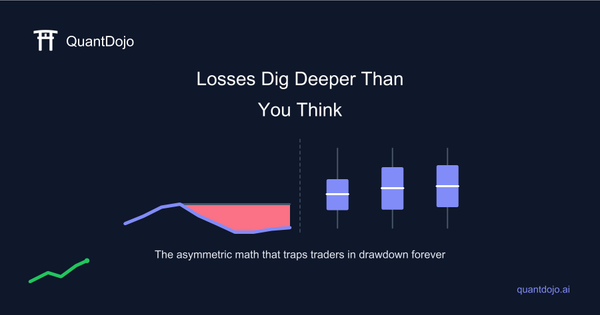
For a deeper look at how a single bad drawdown can become nearly impossible to escape from, the drawdown recovery percentage math article shows the asymmetry most traders don't appreciate until it's too late.
Run Your Own Numbers
Put your actual win rate, payoff ratio, and position size into the Risk of Ruin Calculator and see where you stand. If the number surprises you — that's the point. The formula doesn't care about your confidence in the setup.
If you want to validate whether your strategy's edge is real before worrying about position sizing, quantcheck will flag the statistical red flags in your backtest — free, no signup required for the basic verdict.
Frequently Asked Questions
What inputs do I need to calculate risk of ruin for a trading strategy?
You need three numbers: your historical win rate (fraction of trades that are profitable), your payoff ratio (average winning trade divided by average losing trade), and the fraction of capital you risk per trade. All three interact — a strong win rate can still produce high ruin probability if the payoff ratio is poor or the position size is too large.
Does a positive expected value guarantee I won't blow up?
No. Positive expectancy is necessary but not sufficient for survival. With a positive edge but an oversized position, you can still blow up with high probability — the math above shows this clearly. Expectancy tells you the direction of the drift; position size determines whether the variance destroys you before the edge pays out.
How does risk of ruin change at a prop firm versus a personal account?
At a prop firm, the effective ruin threshold is the firm's maximum drawdown limit — often 5% to 10% — not zero. This compresses your available loss runway dramatically and raises your functional ruin probability relative to the same strategy traded in a personal account. The formula still applies; you simply substitute the prop firm's drawdown limit as your ruin boundary instead of 100% account loss.
The Honest Bottom Line
The risk of ruin formula trading requires isn't exotic. Three inputs. One output. What makes it uncomfortable is that it forces you to be honest about all three at once — not just the win rate you're proud of, but the payoff ratio you're quietly rounding up and the position size you're quietly justifying.
Run the math. Adjust the position size until the ruin probability is something you can live with — literally. Then trade. The market will find every weak point in your framework eventually. The formula just finds them first.
Nothing here is financial advice — just the math that determines whether your account survives long enough for your edge to matter.