Your Backtest Only Sees the Survivors
Test a strategy on today's top coins or stocks and you've already rigged the result. Survivorship bias quietly inflates every backtest that ignores the assets that died.
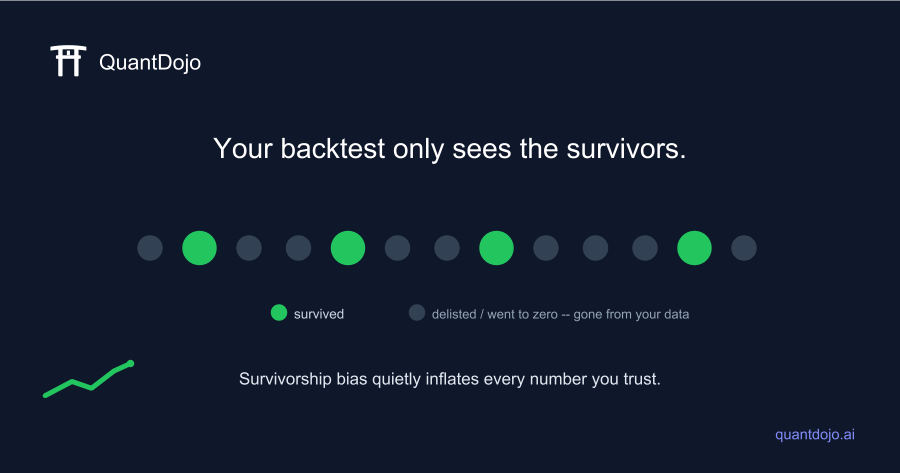
Here's a backtest that sounds rigorous: take the top 100 coins by market cap, or the current S&P 500, and test your strategy across years of their history.
It's already broken. You rigged the result before you wrote a line of strategy code.
What survivorship bias is
Your universe — "today's top 100", "current index members" — is defined entirely by what survived to today. Every coin that went to zero, every stock that was delisted, every token that rug-pulled and vanished is missing from your data. But your strategy, trading back in 2019, didn't know which ones would die. It would have happily bought them.
You're testing a strategy on a list of winners handed to you by the future. That's not a backtest; it's a memorial service for the ones that made it.
The bullet-hole problem
In World War II, the statistician Abraham Wald was asked where to add armor on bombers, based on the bullet holes in the planes that returned. The naive answer: armor where the holes are. Wald's insight: armor where the holes aren't — because the planes hit there never came back to be counted.
A survivorship-biased backtest makes exactly the naive mistake. You study the survivors and conclude the strategy is sound, blind to the assets it would have flown straight into the ground.
Where it bites hardest
- Crypto. Death rates are brutal — thousands of tokens are effectively dead. "Top N by market cap today" is one of the most survivorship-poisoned universes in existence. A momentum strategy backtested on it looks heroic; in real time it would have ridden a graveyard of alts to zero.
- Stocks. Backtesting on current index members silently deletes every bankruptcy and delisting — precisely the disasters a real strategy has to survive.
- Fund & strategy databases. Dead funds drop out, so the surviving average looks far better than reality. Studies put the overstatement at roughly 1–4% per year for equity funds — and far more in high-mortality markets like crypto.
The tell
Ask one question: was my universe chosen using any information from the end of the test period? "Top coins now", "stocks that still exist", "strategies still being sold" — if yes, survivorship bias is baked in, and your numbers are too kind.
How to do it properly
- Use point-in-time data: the universe as it actually was on each date, including assets that later died.
- Include the dead with their real outcomes — the delisting, the −100%, the rug.
- Accept that good, delisting-inclusive data costs money and effort. That cost is exactly why most retail backtests quietly skip it — and why most retail backtests lie.
The honest bottom line
Like lookahead bias, survivorship is a data-integrity problem — upstream of every clever statistic. No Deflated Sharpe Ratio, no walk-forward, no amount of cross-validation can fix a dataset that quietly deleted all the losers. Garbage in, garbage out.
Check what's real — free
Once your data is honest, quantcheck tells you whether the surviving edge is real or just well-dressed noise.
For more, subscribe to the QuantDojo newsletter.
Nothing here is financial advice.