Your Backtest Peeked at the Future. That's Why It Looks Perfect.
Lookahead bias is the quietest backtest killer: a single accidental glance at future data turns random noise into a flawless equity curve. Here's how it sneaks in — and how to catch it.
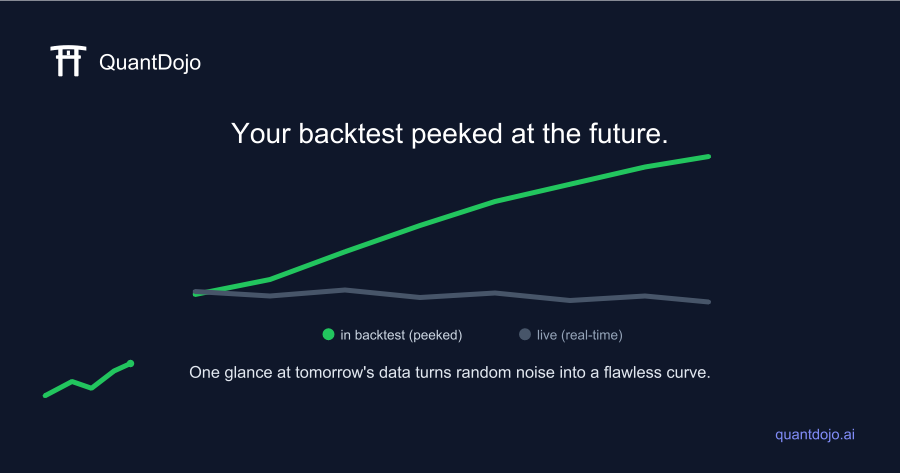
A backtest that looks too good to be true usually is — and the most common reason isn't overfitting. It's that the strategy quietly used information it could never have had at the time.
This is lookahead bias, and it's the deadliest backtest bug there is, because it produces gorgeous results that evaporate the moment you go live.
What lookahead bias actually is
Every backtest makes decisions bar by bar. At each moment, the strategy is only allowed to use data that existed up to that point. Lookahead bias is when — somewhere in your code or your data — a decision secretly uses information from the future. Even a single bar ahead is enough.
It sounds obvious. It almost never is. The leak is usually buried in a data-prep step you'd never think to suspect.
How it sneaks in
- Centered indicators. A rolling z-score, normalization or smoothing computed over a centered window uses bars on both sides — including future ones. Computed once over the whole series it looks fine; bar-by-bar in real time it simply can't exist.
- Whole-series scaling. Normalizing features by the dataset's mean/std (or min/max) leaks the future's distribution into every past bar. The classic ML mistake:
fiton the full data before splitting. - Filling at the signal bar's close. "Entering at the close" means trading on a price you only knew after the bar finished. Realistic fills use the next bar's open.
- Restated or forward-filled fundamentals. Earnings, index membership or revised macro data stamped at the wrong date — and suddenly you "knew" a number before it was published.
Why it's so dangerous
Overfitting at least produces a plausible edge that merely fails to generalize. Lookahead bias produces a fake edge that looks spectacular — high Sharpe, smooth equity curve, tiny drawdown — because the strategy is, in effect, trading with tomorrow's newspaper.
The cruel part: it passes in-sample, out-of-sample and holdout, because the leak is present in all three. Your gates don't catch it. Even a Deflated Sharpe Ratio can't help — the returns you fed it are simply not real.
A useful gut check: if your backtest barely has a drawdown, suspect a leak before you celebrate.
How to catch it
- Compute every feature causally — trailing windows only, re-derived using data up to that bar.
- Fit scalers on training data only, then apply them forward. Never
fiton the full series. - Fill on the next bar. Decide on bar t, execute at the open of t+1.
- The point-in-time test. Re-run the backtest feeding data one bar at a time, as it would have arrived live. If the result collapses, you had a leak. (This is exactly how a lookahead bug in my own old models was finally exposed: full-precompute gave 214 trades; strictly causal gave zero.)
- Be suspicious of perfection. A near-straight equity curve is a red flag, not a trophy.
The honest bottom line
No statistical test can rescue a backtest built on data you couldn't have had. Like survivorship bias, lookahead is a data-integrity problem — upstream of every clever validation method. Garbage in, garbage out.
That's the running lesson of this series: the math (Deflated Sharpe, PBO, Reality Check) only tells the truth if the numbers you feed it are real. Get the data right first — then validate.
Check what's real — free
quantcheck runs the proper, multiple-testing-corrected validation on your returns, once you've made sure they're causally clean. Try it free — no signup for the verdict.
For more no-nonsense breakdowns, subscribe to the QuantDojo newsletter.
Nothing here is financial advice — just a reminder that the most convincing backtest is often the one quietly reading tomorrow's prices.